
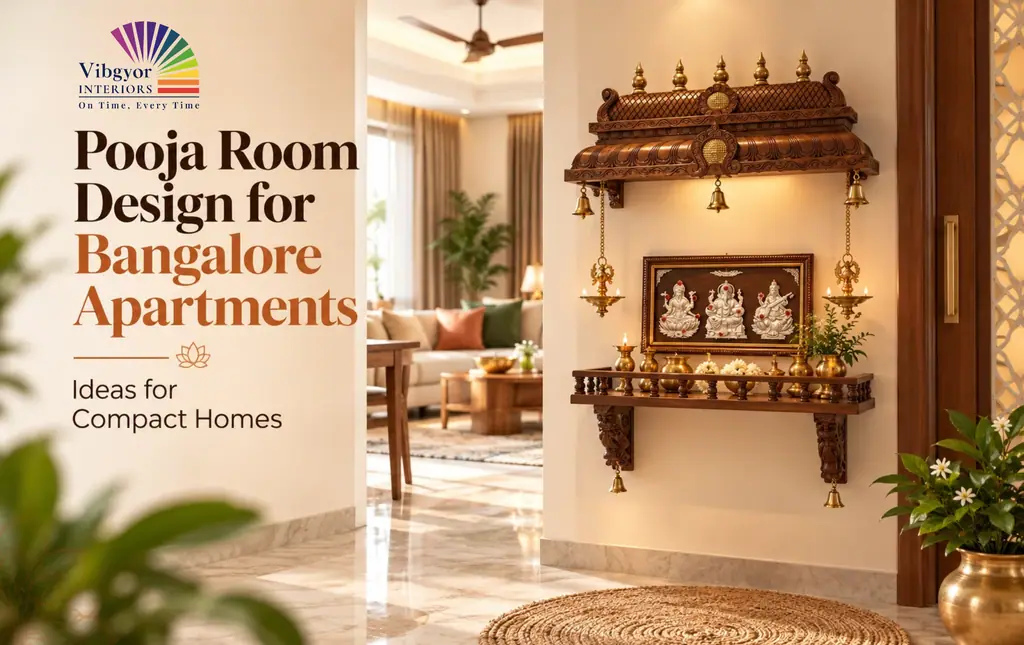
Pooja Room Design for Bangalore Apartments : Ask anyone who has bought a flat in Bangalore what they argued about most during the interiors planning, and there’s a good chance the answer is the pooja space. The builder’s floor plan shows a tiny 2BHK or 3BHK, but there’s rarely a dedicated room for the gods. So where does the mandir go?
The good news is that a beautiful, peaceful pooja room doesn’t need a lot of floor space. It needs clear thinking, a few smart choices and a little Vastu awareness. Here’s how families across Whitefield, Sarjapur Road, HSR Layout, Hebbal and Electronic City are making it work.
Can You Really Have a Pooja Room in a Small Bangalore Apartment?
Yes. A pooja room in a compact apartment can be as small as 2 feet by 2 feet, or even a single wall niche. Most Bangalore flats are between 900 and 1,500 sq ft, so the trick is to design the mandir as part of the home rather than as an add-on squeezed in later.
Think of it as a quiet corner with a purpose. It needs three things: a stable platform for the idols, a place for the diya and agarbatti to be used safely, and a little storage for pooja items. Everything else is a bonus.
1. Wall-Mounted Pooja Units: The Space-Saver
If floor space is tight, go vertical. A wall-mounted pooja unit floats above the ground and keeps the floor clear. Many families like this option because it works in living rooms, passages and even beside the dining area.
Why it works:
- Takes up no floor area
- Can be paired with a drawer or closed cabinet below for storing pooja samagri
- Looks neat and contemporary
Pick a depth of 12 to 15 inches. That’s enough for most idols and a small brass diya without sticking out into the room.
2. Corner Pooja Mandir Designs
Corners are the most underused part of any apartment. A triangular or L-shaped mandir tucks neatly into a corner and gives you more surface area than you’d expect. Add a pair of small shelves above for a Tulsi plant, a bell or framed photographs of elders.
3. Pooja Room Inside a Wardrobe or Cabinet
This one is popular in 2BHK flats where the living room is also the dining room, study and guest area. A pooja cabinet with doors lets you close everything away when you’re done, which feels especially comforting if you like a calm, uncluttered hall.
Use jaali (perforated) panels or fluted wooden doors so the space still feels open and breathable. You can see how sliding and folding doors are used in compact layouts on Vibgyor Interiors.
4. Under-the-Staircase Pooja Space (For Duplex Homes)
If you live in a duplex or villament, the space under the staircase is a natural mandir spot. Add a low platform, warm lighting and a carved back panel, and you have a peaceful nook that feels intentional rather than leftover.
5. The Living Room Mandir That Doesn’t Feel Like a Showroom
Many modern Bangalore families place the mandir in the living room, near the entrance or beside a feature wall. It works well when it blends with the rest of your decor. Keep the same wood tone as your TV unit or console, and the whole room feels coordinated.
Vastu Tips for Pooja Room Design in Apartments
Vastu is a big part of how many families choose the mandir location, so here’s the short, practical version.
- Best direction: North-east is considered the most auspicious corner for a pooja room.
- Alternate directions: North or east are usually fine if north-east isn’t possible.
- Facing direction: Ideally, the person praying faces east or north.
- Avoid: Placing the mandir against a bathroom wall, under a staircase in some traditions, or in the bedroom where possible.
- Idol height: Keep idols at about chest height when you’re seated or standing, not on the floor.
In an apartment, you can’t always get a perfect direction. That’s normal. If the ideal spot isn’t available, most families choose the best possible direction and focus on keeping the space clean, bright and calm. If you’d like help adapting Vastu to your specific floor plan, you can get in touch with the Vibgyor Interiors team.
Materials That Work Well for a Compact Pooja Room
| Material | Why people like it | Good to know |
| Teak or engineered wood | Warm, traditional look | Needs sealing near diya heat |
| Marble | Cool, clean, classic | Heavier and costlier |
| Corian or solid surface | Seamless, easy to wipe | Stylish and low maintenance |
| Brass accents | Adds a traditional touch | Needs occasional polishing |
| Backlit onyx or acrylic panels | Gives a soft glow | Use LED so heat stays low |
For Bangalore’s mild climate, engineered wood with a good laminate or veneer finish is a practical, budget-friendly pick.
Lighting: The Secret to a Peaceful Mandir
You don’t need many fixtures. Use warm white LED lights (around 2700K to 3000K) and keep them soft. A concealed strip light behind the top panel, plus one small spotlight on the main idol, is usually enough. Avoid harsh white lights, which make the corner feel clinical.
If you pray in the early morning or evening, a dimmer switch is a lovely small touch.
Smart Storage Ideas
A pooja space gets cluttered quickly: oil bottles, matchboxes, incense, books, extra diyas, festival cloths. Plan these:
- A pull-out drawer for incense and matchboxes
- A shallow shelf for pooja books
- A closed cabinet below for oil, camphor and spare cloths
- A small hook or rod for the bell and aarti plate
When everything has a place, the room stays calm even on festival days.
Fire Safety in an Apartment Mandir
Since you’ll be lighting diyas and agarbattis, a few simple precautions go a long way:
- Keep a non-flammable base such as stone or tile under the diya.
- Don’t use thick fabric or curtains directly next to the mandir.
- Keep wiring and LED drivers away from the flame area.
- Add a small brass or steel plate under agarbatti stands to catch ash.
Pooja Room Door Design Ideas for Compact Homes
If you’re creating an enclosed pooja space, the door matters as much as the interior. Popular choices include:
- Jaali doors that let light and air pass through
- Sliding doors that save swing space
- Glass doors with frosted or etched patterns, such as a lotus or Om motif
- Carved wooden doors for a traditional feel
In a small flat, sliding or folding doors are usually the smartest choice because they don’t need clearance to open.
How Much Does a Pooja Room Cost in Bangalore?
It depends on size, material and finish. A simple wall-mounted unit will cost far less than a custom carved mandir with marble and backlighting. As a rule of thumb, decide your budget first, then choose the material and detailing that fit within it. A good designer will tell you where to spend (the main backdrop and lighting) and where to save (the sides and storage).
For an exact quote based on your flat, it’s best to speak to a designer directly. You can start by reaching out through the Vibgyor Interiors contact page.
Getting the Pooja Space Ready for Diwali
Diwali is just around the corner, and the pooja corner is the heart of the celebration. A few quick, low-cost updates can make a big difference: fresh paint or a wallpaper panel behind the idols, new brass diyas, a string of warm fairy lights and a rangoli at the entrance. If you’d like more ideas before the festival, here’s a handy read on easy Diwali home decor makeovers.
Why Work With a Local Interior Designer?
Bangalore apartments come with their own quirks: tight corridors, builder-fixed electrical points, columns in odd places and strict society rules about what you can and can’t change. A designer who works in the city regularly knows how to deal with these. They can also coordinate carpentry, electrical work and finishing so your pooja unit fits into the larger design of the home. To see the kind of work they do, take a look at the Vibgyor Interiors website.
Quick Checklist Before You Finalise Your Pooja Room
- Have you picked the best possible direction (north-east, north or east)?
- Is the mandir away from the bathroom wall and the main bedroom?
- Is there a heat-safe surface under the diya?
- Do you have enough storage for pooja items?
- Is the lighting warm and soft?
- Can the mandir be closed or screened when you want privacy?
Frequently Asked Questions
What is the best size for a pooja room in a small apartment?
A pooja space can be as compact as 2 ft x 2 ft for a wall-mounted unit, or about 3 ft x 3 ft if you want to sit and pray inside. The right size depends on how many idols you have and how many people pray together.
Which direction is best for a pooja room in an apartment?
North-east is traditionally considered the best direction. North and east are also acceptable. If none of these is possible, choose the closest option and keep the area clean and well lit.
Can I put the pooja unit in the living room?
Yes. Many modern apartments place the mandir in the living room or near the entrance. Just avoid placing it directly opposite the main door or next to the bathroom wall.
Can I keep the pooja unit in the bedroom?
It’s generally best avoided. If you have no other option, use a closed cabinet or a curtain to screen the mandir at night.
What are the best materials for a pooja room in Bangalore?
Engineered wood, marble, solid surface and brass accents are the most popular. Choose materials that are easy to clean and heat-resistant near the diya.
Is a wall-mounted pooja unit a good option?
Yes, especially for 1BHK and 2BHK homes. It saves floor space and can include storage below.
What lighting is best for a pooja room?
Warm white LED lights (2700K to 3000K) create a soft, peaceful glow without producing much heat.
How can I decorate my pooja room for Diwali?
Use fresh flowers, brass diyas, warm fairy lights and a small rangoli. Switch to brighter or festive fabrics for the backdrop.
Final Thoughts
A pooja room doesn’t have to be big to feel sacred. In a Bangalore apartment, it’s about making the most of what you have: a wall, a corner, a cabinet, a quiet moment in the morning. With a thoughtful layout, good lighting and a design that fits your home, even the smallest mandir can feel like the calmest corner of the house.
If you’re planning one, start with the space you have, choose the direction as best you can, and talk to a designer who understands compact Bangalore homes. You can reach the Vibgyor Interiors team here or explore more ideas on their website.
Found this useful? Save it for later or share it.
Topics covered: